

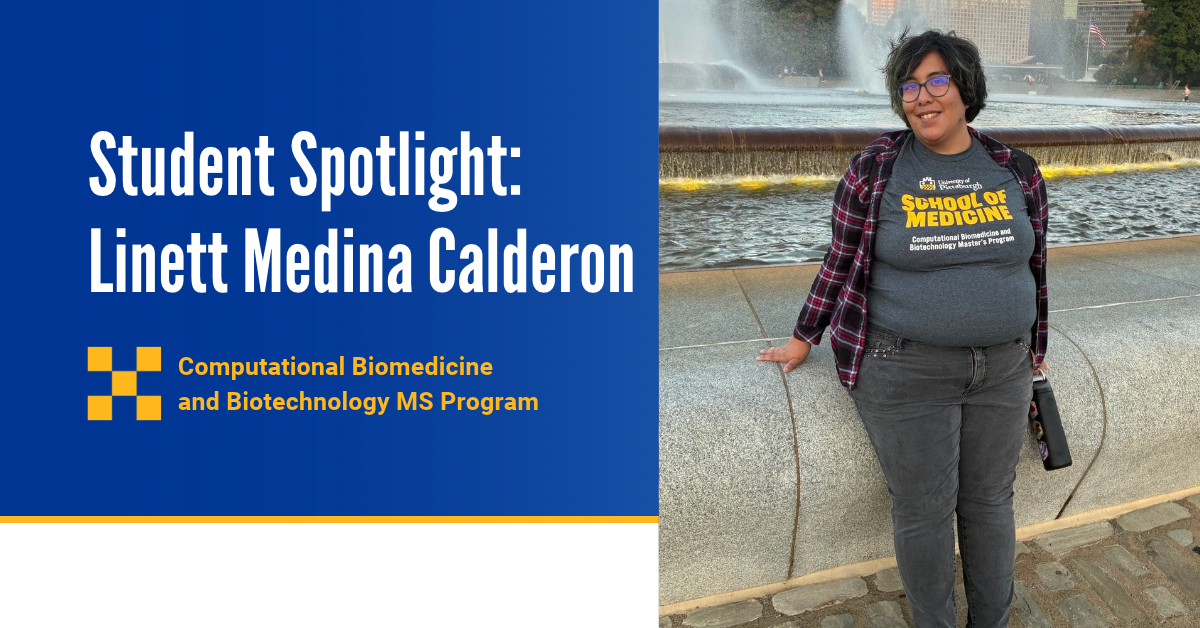
After graduating from UC Davis with a bachelor’s degree in biochemistry and molecular biology, Linett Medina Calderon spent time working as a research associate for a biotechnology lab. However, she realized the processes startup labs use can sometimes be slow and manual. This sparked her interest in programming and the creation of bioinformatics pipelines to streamline these processes and make labs more efficient.
She gained experience as a software engineer for the same biotechnology lab, and then she decided to explore graduate school programs that would strengthen her knowledge of bioinformatics. Now, Medina Calderon is a first-year student in the Computational Biomedicine and Biotechnology (CoBB) master’s degree program at the University of Pittsburgh.
At Pitt, she has had the opportunity to build upon her existing wet lab skills with classes in computational biology and bioinformatics.
Building a computational biology toolkit
“I like being able to develop tools, and I’m also able to understand the context because I have a background in wet labs,” Medina Calderon said. “I like that when I’m building a computational tool, I’m able to think about how I would use it if I was at a lab bench and how it would benefit me.”
She also works part-time as a research technician and bioinformatician for the lab of Fritz Roth. The Roth lab focuses on designing large-scale experiments to understand how genetic variation relates to human disease.
In this role, she maintains the lab’s MAVE (Multiplexed Assays of Variant Effect) bioinformatics pipeline. This genomic method processes sequencing data to calculate protein variants’ fitness scores and provides a suite of quality control visualizations. She debugs issues with the pipeline and assists labs from other universities who use it for their research.
Gaining real-world experience in the lab
Medina Calderon said the information she has learned from her CoBB classes has come in handy for her research technician role. For example, her Intro to Bioinformatics class recently had a module on accessible science design, which she applied to the color gradients for the Roth Lab’s MAVE pipeline.
“I like the application aspect of the program and the classes. We learn the concept and then we do an applicable project based on it,” she said. “It’s not just textbook pipelines with data that works perfectly, and I feel like that’s more realistic to how it will seem in research.”
As she looks forward to a future career path, Medina Calderon hopes to pursue a PhD and land a job in academia that will allow her to combine her interests in teaching and research.
Exploring opportunities in Pittsburgh
When she is not in the lab or in the classroom, Medina Calderon can be found exploring Pittsburgh neighborhoods, reading books by her favorite author Rainbow Rowell, or planting herbs in her garden. Moving from the West Coast to Pittsburgh has been an adjustment, but she is getting used to the city’s colder weather and enjoying the opportunities the region offers.
She offers students interested in the CoBB program one piece of advice: “Take advantage of the space here in the master’s program. I feel like I’m not just here to take classes and learn but also to connect with the faculty and other grad students and learn more about their research and how they got there. That’s a valuable experience for me.”