

Computational and Systems Biology
Education
Menu
Contact us
Have a question? Interested in learning more about our programs and events? Contact us via the form linked below.
Training the next generation of computational biologists
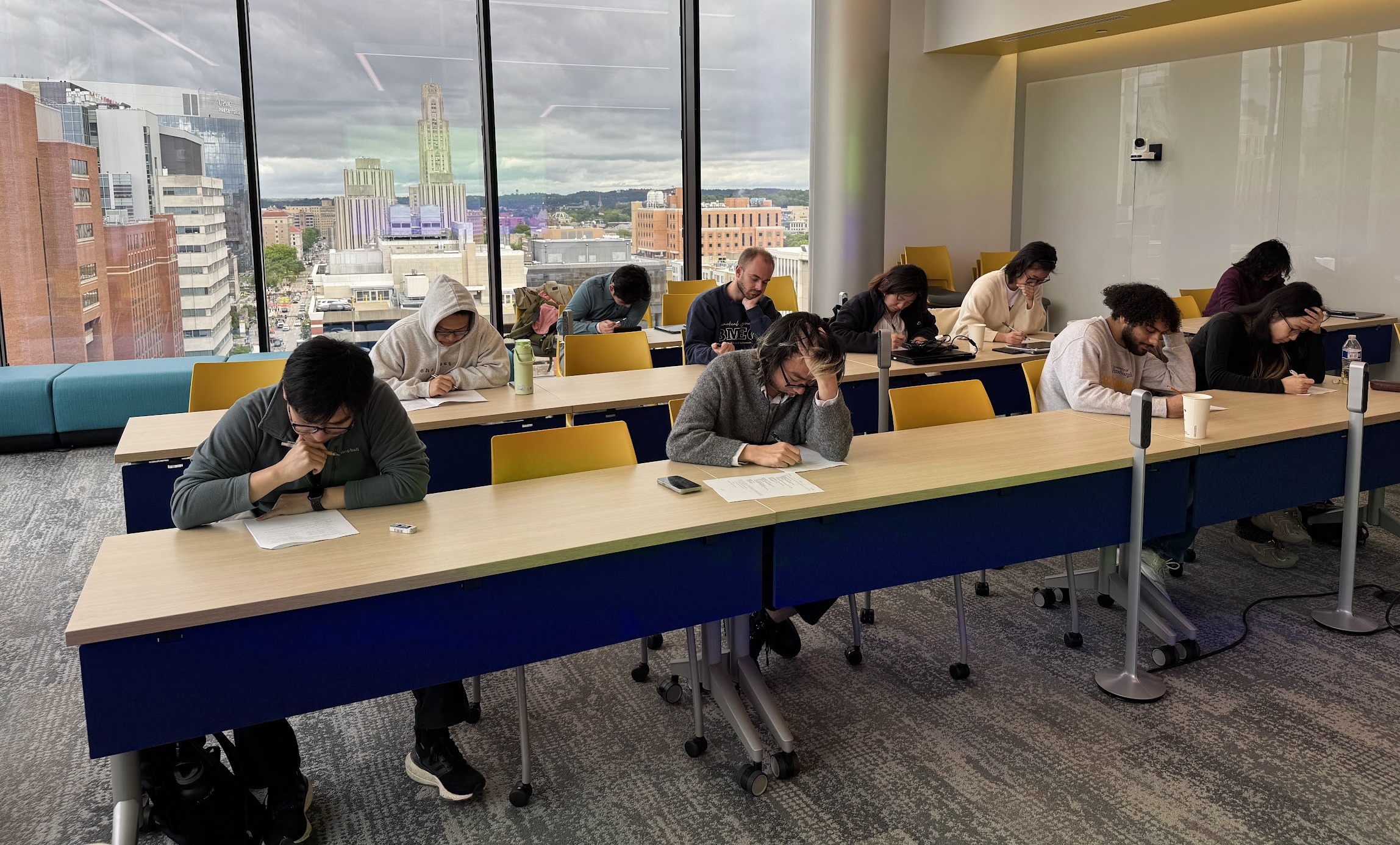 The Department of Computational and Systems Biology offers research-centered training opportunities for learners at every stage, from high school summer research to undergraduate research experiences, master’s training and doctoral study. Our educational programs prepare students to build and apply computational methods that address real biomedical problems in genomics, structural biology, bioimage analysis, systems modeling, machine learning, drug discovery and biotechnology.

Doctoral training
Joint CMU-Pitt Computational Biology PhD Program
Interdisciplinary doctoral training at the interface of biology, medicine, computer science, mathematics and engineering.
Build the Future
Master’s program
Computational Biomedicine & Biotechnology MS
Master’s training for careers in pharmaceutical R&D, biotechnology, health informatics, digital health and academia.

Undergraduate research
Training and Experimentation in Computational Biology REU
A 10-week summer research experience for undergraduates focused on computational, quantitative and systems-level biology.

High school research
CompBio Academy
Summer research opportunity introducing high school students to computational biology and cancer-focused biomedical research.
Courses
FOUNDATIONS OF COMPUTATIONAL BIOLOGY | COBB 2010
(3 credits, Fall)
This course introduces students to the essential concepts, tools and techniques of modern computational biology with real-world examples. It covers mathematical concepts, including linear algebra, differential equations and statistics, that are central to modeling biological systems. Students will learn the basic theory behind widely used techniques, such as automated clustering, parameter estimation, sampling and numerical integration. Project-based assignments in R and Python center around real-world computational biology problems from genomics, structural biology and systems modeling. Prerequisites: Although there are no official prerequisites, it is highly recommended that students wishing to enroll in this course understand differential calculus and at least one semester of programming. This course is open to graduate students and upper-level undergraduates.
INTRODUCTION TO GENOMICS (SYSTEMS BIOLOGY 1)| ISB 2020 | COBB 2021
(3 credits, Fall)
This course introduces students to genomic data and the basic analytical principles pertaining it. Students will learn about high-throughput sequencing methods and applications, genomic variation, transcriptomics and epigenomic data. At the end of the course, the students will be able to efficiently analyze these types of datasets using existing algorithms or algorithms they will develop.
INTRODUCTION TO BIOINFORMATICS PROGRAMMING IN PYTHON | COBB 2025
(3 credits, Fall)
This course will introduce students to a selection of popular Python packages used in bioinformatics and computational and systems biology. Students will be graded on programming assignments. Each assignment will explore a different subdiscipline of computational biology and introduce students to a new Python package. Optional recitations will be available and will assist students in developing basic programming skills.
MODERN METHODS IN STRUCTURE-BASED DRUG DISCOVERY | COBB 2035
(4 credits, Fall)
This course introduces students to the modern computational approaches and governing physical and chemical principles that underpin structure-based drug discovery. The course explores how biomolecular structure and dynamics inform the rational design of therapeutics and how machine learning can be harnessed to improve drug discovery. Topics include molecular interactions, statistical mechanics and thermodynamics, molecular simulations, coarse-grained and enhanced sampling techniques, free energy calculations, protein structure prediction, protein design, molecular docking and virtual screening. Students will engage with methods for structure-based drug discovery in hands-on assignments and recitations.
PROFESSIONAL DEVELOPMENT | COBB 2055
(1 credit, Fall and Spring)
This course addresses aspects of skills essential for establishing and maintaining a career in computational biomedicine and biotechnology. Topics covered include preparation of a curriculum vitae and resume, interview skills, research ethics, mentoring and communicating with managers and team members.
MACHINE LEARNING FOR BIOMEDICAL APPLICATIONS | COBB 2060
(4 credits, Spring)
Modern high-throughput techniques generate vast quantities of data—from molecule to patient—spanning whole-genome sequencing, RNA-seq transcriptome profiling, high-throughput mass spectrometry, biochemical screening, flow cytometry, high-content screening and analyses of literature and electronic medical records. To be effective, biomedical researchers require the appropriate computational tools to correctly interpret and use this data. Machine learning, the science of finding and applying patterns in data, is an essential tool for turning data into knowledge and actionable insights and has been rising in prominence in biomedical research. This course will focus on the practical aspects of effectively applying state-of-the-art machine learning methods to biomedically relevant datasets. Topics covered include mathematical foundations, practical coding skills, classical machine learning, deep learning and generative modeling.
SEMINAR IN COMPUTATIONAL BIOLOGY | MSCBIO 2010
(1 credit, Fall and Spring)
Seminar series of the joint Pitt-CMU PhD program in computational biology. Nationally and internationally recognized researchers in the field of computational biology present scientific findings. Students meet informally with each speaker to discuss key areas of computational biology, including computational structural biology, computational genomics, cellular and systems modeling, bioimage informatics and computational neurobiology.
BIOIMAGING, ANALYSIS AND SPATIAL BIOLOGY | MSCBIO 2027
(3 credits, Spring)
This course will introduce students to micron, nanometer and subnanometer scale imaging-based approaches in experimental, computational and systems biology. Emphasis will be placed on understanding the fundamentals of image formation, processing and analysis of brightfield, phase-contrast, highly multiplexed, super-resolution, live-cell, cryo-EM and computational imaging, along with imaging-based spatial transcriptomic methods. Applications of these methods in studying biological phenomena in space and time will also be discussed. Python will be the programming language in which image processing, machine learning and system biology methods introduced in the course will be implemented. Students are expected to know Python basics. It is also expected that students have a basic understanding of linear algebra and calculus.
CELLULAR, SYSTEMS, AND MOLECULAR MODELING | MSCBIO 2041
(4 credits, Spring)
The Cellular, Systems and Molecular Modeling course takes on the ambitious task of studying the dynamics of biological modeling and biomedical processes from a whole system point of view. The observed systems range over orders of magnitude, from tissue to cells to molecular assemblies. Engineering tools are used along with genome-scale information in mathematical and/or computational models that usually adopt a top-down approach. Typical tasks include, modeling diseases, entire ‘virtual’ cells or subcellular networks of interactions. Major research topics cover the modeling of complex signaling and regulatory networks, transport mechanisms and spatio-temporal evolution of microphysiological events, as well as establishing the links between the development of complex phenotypes and seemingly unrelated molecular events.
CRITICAL THINKING IN COMPUTATIONAL BIOLOGY | MSCBIO 2043
(2 credits, Fall)
This is an upper level critical paper reading and discussion course in the areas of experimental genomics. Introductory lectures will be interspersed within the topic blocks, with most of the meeting time devoted to critical discussion of assigned journal articles. Students will be responsible for leading class discussions and fielding questions on those articles. There will be written and oral presentations of final student proposals at the end of the semester.
LABORATORY METHODS FOR COMPUTATIONAL BIOLOGY | MSCBIO 2050
(2 credits, Spring and Fall)
Computational biologists frequently focus on analyzing and modeling large amounts of biological data, often from high-throughput assays or diverse sources. It is therefore critical that students training in computational biology be familiar with the paradigms and methods of experimentation and measurement that lead to the production of these datasets. This one-semester laboratory course gives students a deeper appreciation of the principles and challenges of biological experimentation. Students learn a range of topics, including experimental design, structural biology, next generation sequencing, genomics, proteomics, bioimaging and high-content screening. Class sessions are primarily devoted to designing and performing experiments in the lab using the above techniques. Students are required to keep a detailed laboratory notebook of their experiments and summarize their resulting data in written abstracts and oral presentations given in class-hosted lab meetings. With an emphasis on the basics of experimentation and broad views of multiple cutting-edge and high-throughput techniques, this course is appropriate for students who have never taken a traditional undergraduate biology lab course, as well as those with experience who are seeking introductory training in more advanced approaches. The course touches upon a range of topics, including structural biology, genomics, proteomics and bioimaging. A different laboratory method is covered each week, in the lab of a host faculty member who uses that method. The theory and practical aspects of each method are covered during a lecture session prior to each lab session. Students are required to submit a short lab report each week, summarizing the goals of the experiment, the critical steps and sources of error and the analysis of the resulting data. With an emphasis on instrumentation and high-throughput data collection, this course is appropriate for students who have never taken a traditional undergraduate biology lab course, as well as those who have.