

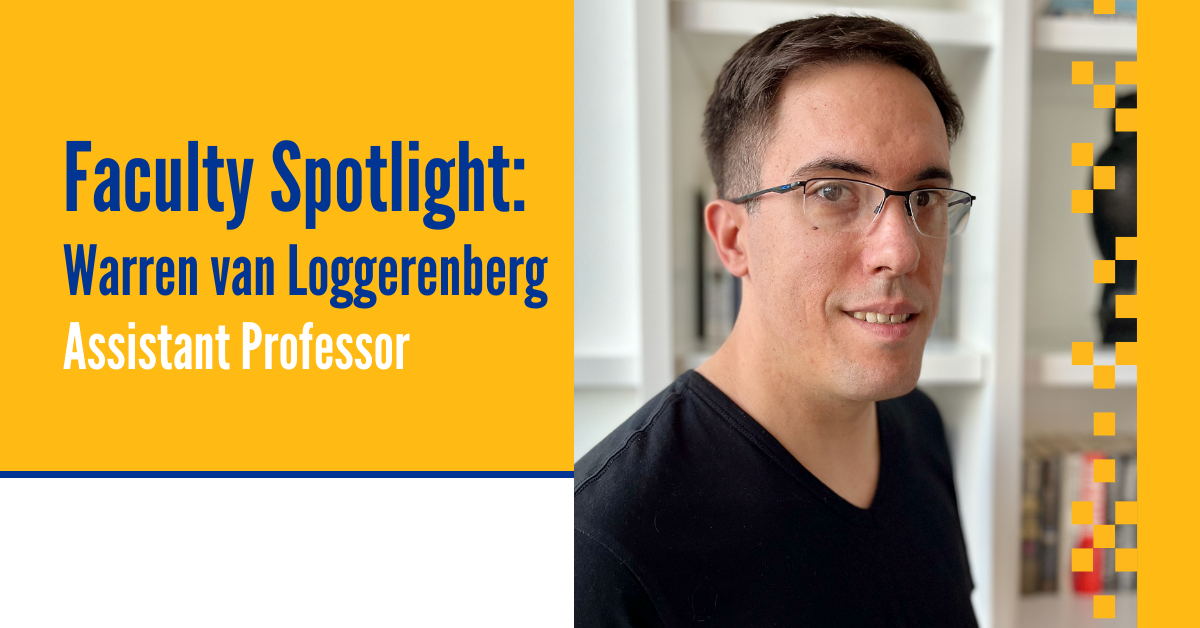
From a young age, Warren van Loggerenberg dreamed of becoming a professor. That dream is now becoming reality as he transitions from a research scientist to an assistant professor in the Department of Computational and Systems Biology (CSB).
Van Loggerenberg earned his bachelor’s degree in pre-medicine and biochemistry from the University of Guelph. He then pursued his PhD in molecular and cellular biology from the same university with a focus on quality control in ribosome biogenesis. After graduating, he sought a postdoctoral position with a more translational aspect.
This led him to CSB department chair Fritz Roth, who at the time was working at the University of Toronto. Van Loggerenberg joined Roth’s group in 2017 as a postdoctoral associate.
“I happened to catch the wave at the exact right moment,” van Loggerenberg said. “I became aware of Fritz’s work with multiplex assays of variant effects—systematically measuring the functional impact of all missense variants in human genes of interest to generate high-resolution sequence-function maps (variant effect maps) and translating this functional data into clinically actionable evidence.”
This work was a good fit for van Loggerenberg because it provided the opportunity to pursue research broadly on metabolic, neurodegenerative and immunologically relevant diseases. As a postdoctoral researcher, he produced variant effect maps for genes associated with acute hepatic porphyria, amyotrophic lateral sclerosis and chronic inherited metabolic disorders.
When Roth accepted a position as a professor and chair for the University of Pittsburgh in 2023, van Loggerenberg decided to follow and became a research scientist in the Roth lab. He was excited by the opportunities for research collaboration that Pittsburgh offers with its connections to local hospitals like UPMC.
Now that van Loggerenberg has a few years of lab experience under his belt, he has accepted a new role as an assistant professor. This switch will allow him to focus on his own research areas, particularly exploring the environment and context-dependence of variant effect maps and their clinical utility. He will also assist in clinical variant interpretation and revealing new gene-trait associations.
“With Fritz’s mentorship and guidance, I’m looking forward to being able to set my own path for growth and research effort,” van Loggerenberg said.
Outside of his work for CSB, van Loggerenberg enjoys spending time with his wife and young son. He also likes downhill biking and can be found cruising the trails of Snowshoe Mountain in West Virginia.
As he embarks on his new journey, he leaves young scientists with an important piece of advice for their careers. “The most important aspect in academia is finding the right mentor. If you have the right mentorship, that’ll help you in your career to find your path and land the right position.”