

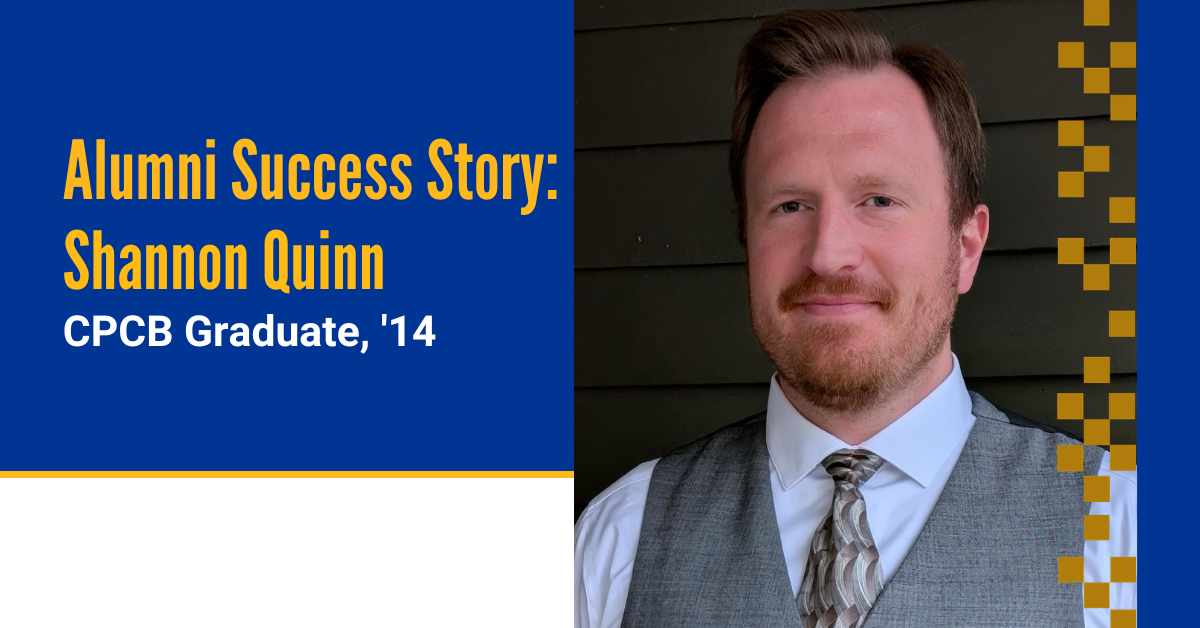
Shannon Quinn is driven by solving complex problems that lead to advances in drug discovery. The 2014 alumnus of the Joint Carnegie Mellon-University of Pittsburgh PhD Program in Computational Biology (CPCB) now works as a senior staff machine learning engineer at Valo Health. Valo Health is a biotechnology company that uses in-house laboratories, large-scale pharmaceutical data, and causal AI and machine learning to transform the drug discovery process.
“It’s challenging in all the best ways,” Quinn said. “There’s a direct line from what I’m working on to the benefits for patients, and that is incredibly fulfilling and rewarding.”
Quinn is currently working on a project exploring biomarkers related to Parkinson’s disease with the goal of finding potential treatment avenues. As a machine learning engineer with an extensive cellular biology background, his job is to make the lives of biologists, clinicians and epidemiologists easier. He works in close consultation with stakeholders to build the tools that he would have wanted as a cellular biologist.
Before working in the drug discovery industry, Quinn was a tenured professor at University of Georgia for 10 years. He taught in the computer science and cell biology departments. After taking a sabbatical to work at a spatial biology company, he realized that pursuing projects related to cell staging and disease progression that helped people was his true calling.
“I love going into a room where everybody is smarter than I am and coming up with the craziest, off the wall ideas,” he said. “It’s also really rewarding to work at a company that strongly values empathy.”
Quinn says that earning his computational biology PhD left him with lifelong skills he still uses today. As a PhD student, he spent a year working at the Children’s Hospital of Pittsburgh with Associate Professor Chakra Chennubhotla. This experience gave him the chance to understand the viewpoints of both computer scientists and clinicians.
“I think the biggest asset of the CPCB program is that it provides students with interdisciplinary research work,” Quinn said. “That’s what I do now, and I don’t know if I would be where I am today without those four years of training.”

In addition to the benefits of his CPCB coursework, Quinn also made lasting friends from the program. He recalls exploring Pittsburgh with his classmates and celebrating after every exam by playing video games together in his apartment. Years later, he keeps in touch with members of his cohort and even had a classmate as a member of his wedding party.
Quinn leaves current students with one piece of advice: “Graduate school is not about who’s smartest. The most important thing for research is just continuing to try things after everything else has failed. You need to have the ability to take a step back and reevaluate and just jeep trying.”